Exam + Showcase
All Domains — D1 17% / D2 40% / D3 24% / D4 19%
Learning Objectives
- Consolidate the week's material across all four SecAI+ domains in the morning review session
- Demonstrate SecAI+ domain mastery across all four domains in the afternoon exam session
- Evaluate AI classroom tool patterns (lab generators, AI tutoring, MCP exercise environments, coding-agent workflows)
- Compare hosted-API vs. local-LLM trade-offs for classroom deployments (cost, privacy, latency, capability, compliance)
- Discuss adoption paths and customization strategies for workshop tools in your own curriculum
Lecture Notes
How today works
Day 5 has two halves. The morning is a guided review session across all four SecAI+ domains — the exam warm-up; the afternoon opens with the graded exam, and the remaining time is lab catch-up so everyone can finish any unfinished lab modules before final grades are recorded.
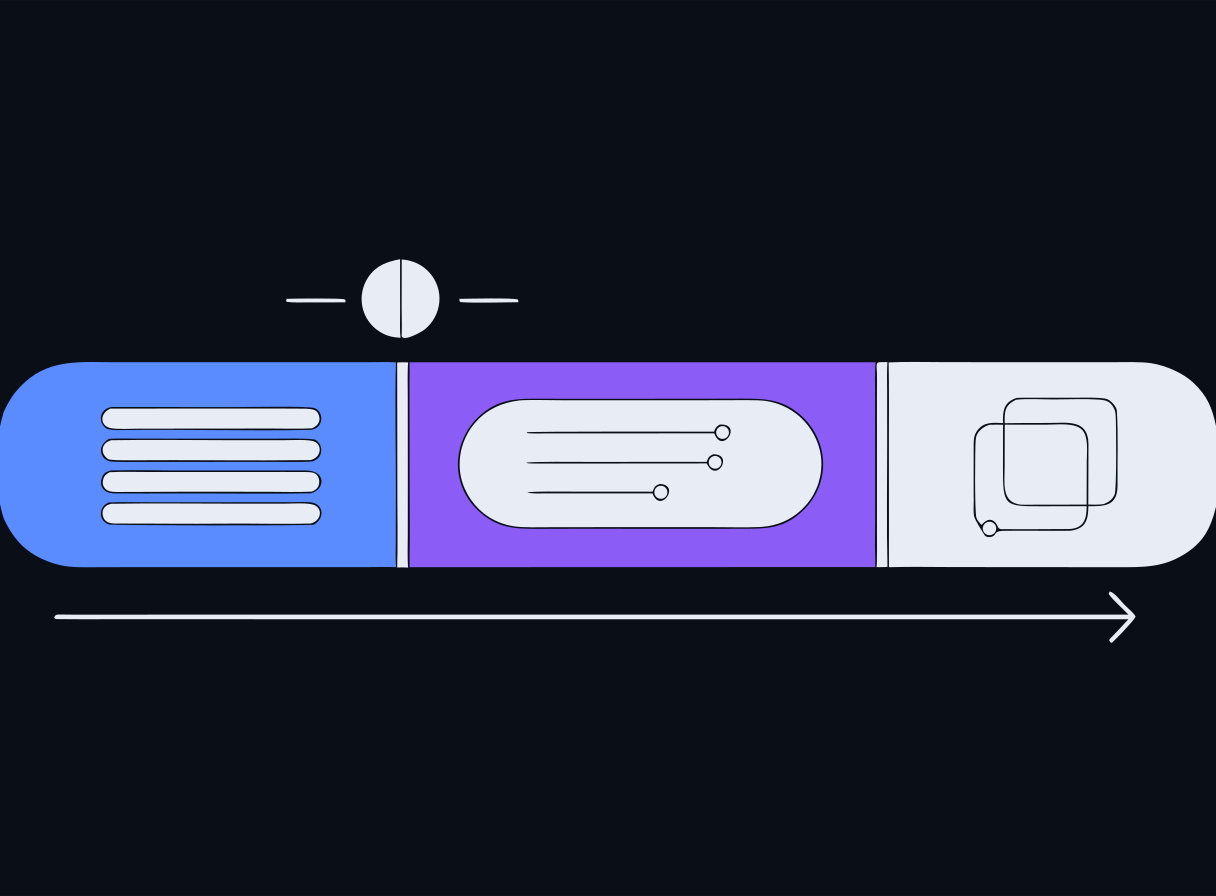 The shape of Day 5, start to finish
Morning — the week in review
The morning is a full review deck pulling the whole week together: Day 1 foundations, the Day 2 threat-model-and-defend material (the 40% domain — it gets the biggest block), Day 3 data protection and governance, and Day 4’s AI-assisted SecOps. It includes embedded checks-for-understanding as practice exam items.
Open the Day 5 review deck →Use the review to find your weak spots, then spend lunch skimming the matching Day 1–4 notes and end-of-day quizzes — they were formative practice for exactly these topics.
The four domains — a study guide
The exam is weighted. Spend your revision time in proportion: Securing AI is 40% and deserves the most.
Domain 1 — Basic AI Concepts (17%)
The vocabulary everything else is built on. Be able to explain, in a sentence each: model / training / inference, tokens (the unit of both meaning and billing) and the context window, embeddings and why similar meanings sit close in vector space, attention + autoregressive generation, and the RAG pipeline (ingest → embed → store → retrieve → generate). Know discriminative vs. generative and LLM vs. SLM (same architecture, different scale). The security hinge: it is all one stream of tokens — the model has no privileged channel separating instructions from data.
Domain 2 — Securing AI Systems (40% — the big one)
Know the OWASP LLM Top 10 (2025) by number, name, and the control each needs — and the through-line: the control lives outside the model. Watch the two confusable pairs: LLM01 (input) vs. LLM05 (output) and LLM03 (component) vs. LLM04 (data). Distinguish references (OWASP, MITRE ATLAS — you enumerate with them) from controls (guardrails, gateways — they stop things). Know the defense layers: a guardrail inspects content (input/output scanning); a gateway controls access (rate limits, token budgets, tiered keys). Data protection: the three states (at rest / in transit / in use), and that redaction at the input is the real control — you cannot leak what is not there. And the thesis: alignment is not a control.
Domain 3 — AI-Assisted Security (24%)
The lens flips: AI as the analyst’s tool. Know MCP (one protocol instead of N×M bespoke integrations) and the tool-call round-trip (the model reasons, the tool provides ground truth). Know the generate → validate → repair loop and why the validate step is non-negotiable — an AI-drafted detection that matches nothing, or everything, is worse than none. Know right-sizing: escalate from a local SLM to a hosted model only when the task demands it and the data-sensitivity allows it. And the symmetry: the same capability serves offense and defense.
Domain 4 — Governance, Risk & Compliance (19%)
The rules of the road. Know NIST AI RMF 1.0 (Govern, Map, Measure, Manage) and its AI 600-1 GenAI profile. Know the EU AI Act risk tiers (unacceptable / high / limited / minimal) and that high-risk obligations were deferred to 2 December 2027 (verify — provisional). Know Shadow AI as a Govern problem and the shape of a responsible-AI program.
The one idea that answers half the questions For almost any “which control?” question in Domains 2–3: the model cannot be trusted to police itself, so the control sits outside it — a scanner, an allow-list, a gateway limit, output validation, a human in the loop. When a question offers “a better prompt” or “the model refuses” as an option, it is usually the distractor.
After lunch — the exam
The exam opens at 1:00 PM Central. Enter the access code the instructor gave you (SECAI-XXXX) in the runner below to begin.
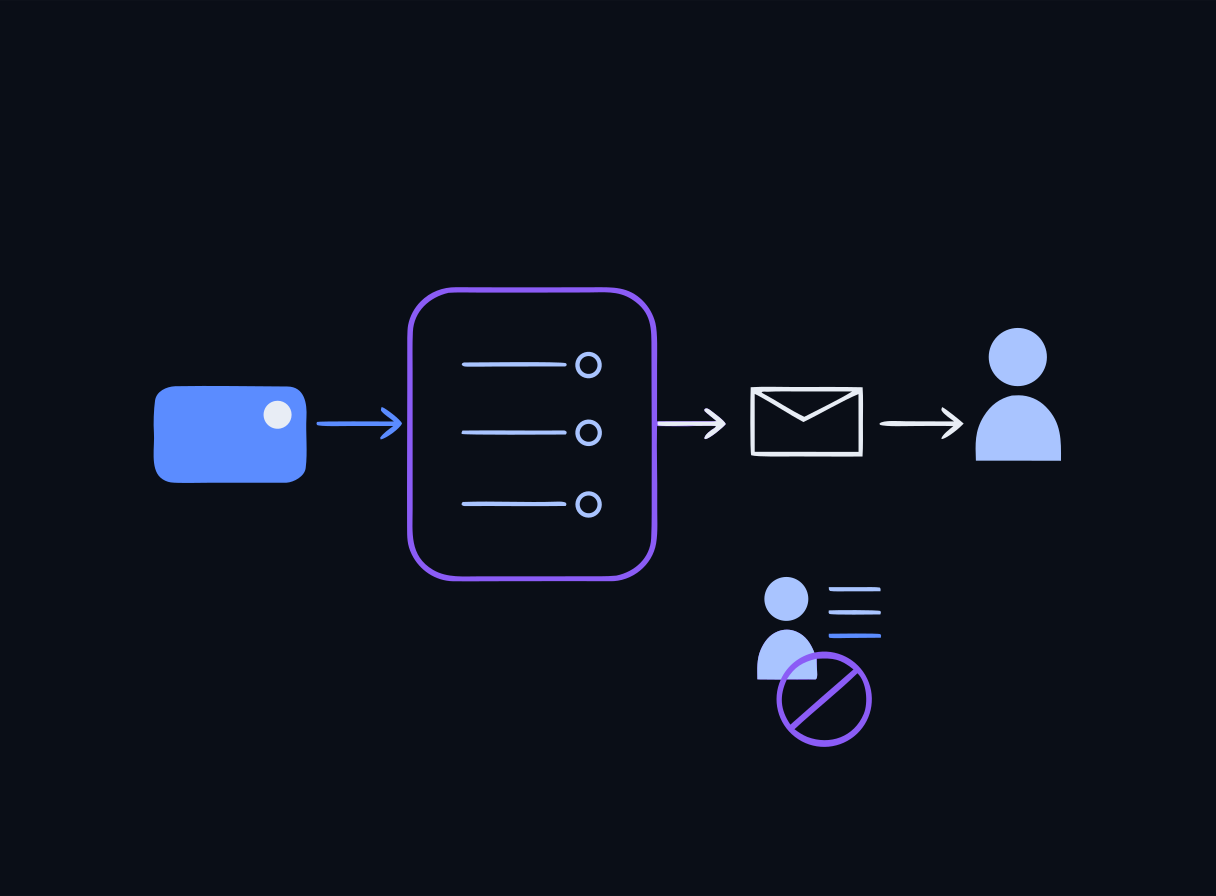 Your code is the identity — no personal data
- Coverage: all four domains, blueprint-weighted — D1 (17%), D2 (40%), D3 (24%), D4 (19%). Everything from the week is fair game.
- Format: multiple-choice and short scenario questions; 80% to pass, with one retake if needed.
- Time: you have the full afternoon session — pace yourself and submit when ready.
- Results: auto-graded and emailed to the instructor; your access code is your identity, so there is no PII to enter.
Before you start Skim your Day 1-4 notes and the end-of-day quizzes — they were formative practice for exactly these topics. Read each scenario question fully before answering; the domain weighting means the Day 2 “Securing AI Systems” material carries the most points.
Full domain weights and exam mechanics are on the Exam page.
After the exam — lab catch-up
Once you submit, the rest of the afternoon is lab catch-up: finish any lab modules you haven’t completed yet — from the core Day 1–4 labs to the go-deeper bundles on each day’s page. Lab completion is recorded today, so the instructor can finalize grades before the workshop closes. Instructors and TAs circulate to help you get unstuck.
If you finish the exam and your labs early, the showcase and roundtable material is available as a later-afternoon option — a tour of patterns, not production systems, that you can adapt for your classroom:
- Lab generators — AI-assisted creation of lab scenarios mapped to objectives.
- AI tutoring — a local LLM as a Socratic tutor grounded on course materials.
- MCP exercise environments — MCP servers wrapping simulated SOC tooling (building on the Day 4 lab).
- Coding-agent workflows — the generate → validate → repair loop for security scripts and detection rules.
- Hosted API vs. local LLM trade-off talk + roundtable — cost, privacy, latency, capability, and compliance, plus how to adopt and customize these tools in your own curriculum.
Bring the questions you have been saving all week — the roundtable is the place to work out how this fits your program. Pattern cards and architecture notes live on the Showcase page.
Afternoon Exam Session
The exam opens at 1:00 PM, after the morning review session. Enter your access code (SECAI-XXXX) to begin. You have the full afternoon session; submit when ready. Results are emailed to the instructor.
Full exam details and domain weights: Exam page.
After the Exam — Lab Catch-Up & Showcase
Once you submit the exam, the priority is lab catch-up: finish any unfinished labs from the week (completion is recorded for your final grade). If time permits, we close with a showcase tour of AI classroom tools — patterns and demos, no production infrastructure exposed.
AI-assisted generation of lab scenarios mapped to security objectives.
Local LLM as a Socratic tutor grounded on course materials.
MCP servers with simulated SOC tooling — no live network access.
Generate → validate → repair loop for security scripts and detection rules.
Cost, privacy, latency, capability, compliance — and adoption strategies for your classroom.
Pattern cards and architecture notes: Showcase page.